
E-commerce SEO Services
Categories and smart filters as landing pages, marked-up product cards and clean indexing. Organic traffic that overtakes the paid channel.
Goals we set for the website
- ×2-3
- organic traffic in 6-9 months
- TOP-10
- for category queries
- −30%+
- ad share of revenue
Sound familiar?
The store lives on ads: ROAS worsens, but switching off means orders stop
Faceted filters spawned thousands of junk URLs — crawl budget burns for nothing
Categories compete with each other in results — rankings bounce instead of growing
Thousands of product cards without unique descriptions — Google sees supplier duplicates
E-commerce SEO Services
What's included
Category architecture
The niche demand map, categories split by intent — internal competition ends
Faceted landing pages
"Affordable corner sofas" — a filter becomes a page with meta and copy
Product templates
Metas and descriptions generated from attributes — thousands of cards optimized systematically
Technical SEO
Indexing under control: duplicates merged, junk blocked, speed in the green
Product markup
Price, availability, rating and reviews in the snippet — higher CTR at the same positions
Business reporting
Not traffic for traffic's sake: orders, revenue and organic vs paid economics
How the project runs
How the project runs
- 2-3 weeks
Audit & keywords
Technical audit, competitor analysis, niche keyword research and clustering
- 3-4 weeks
Strategy & foundation
A month-by-month plan, technical cleanup, landing page structure
- 2-4 months
Content & optimization
Cluster pages, expert content, schema markup, link profile
- monthly
Growth & reporting
Rankings, traffic and leads in reports — strategy adjusts to data
A store on the ad needle — and how stores get off it
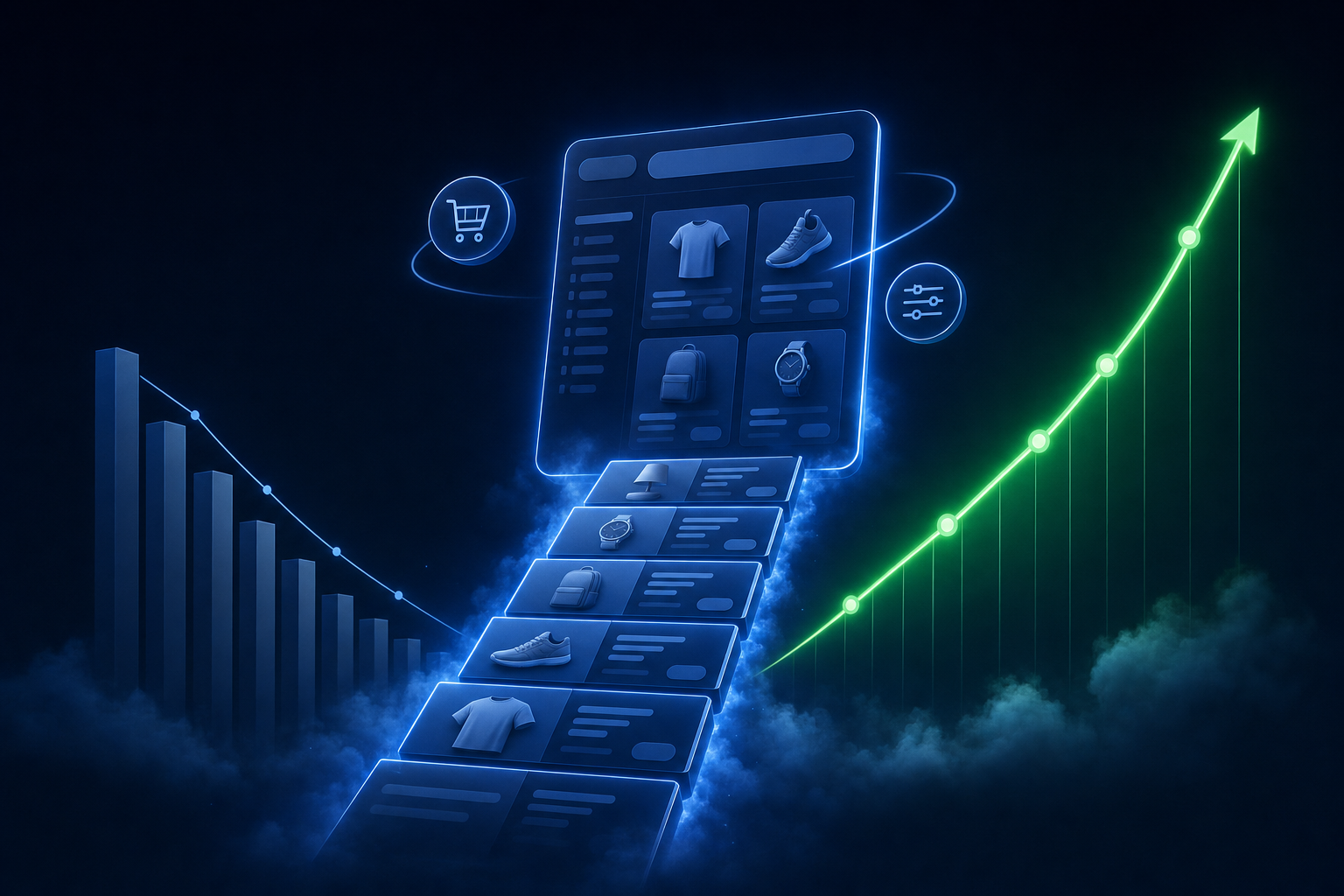
A store’s typical economics look like this. Ads bring orders, the ad-to-revenue ratio creeps up, switching off is scary — sales would stop. Organic works differently. A page that reached the TOP for a category query brings buyers for months with no per-click payment. The investment doesn’t burn with the budget, it compounds. Our reference case: an 8,000-SKU store grew organic 2.8x in eight months. It overtook paid traffic and became the main channel.
Facets: where stores lose and build their organic
E-commerce’s main technical specific is faceted filters. They spawn thousands of URLs, and unmanaged that’s a catastrophe. The crawl budget burns on junk, duplicates choke the rankings. But the same facets hide the main lever. Combinations people actually search — affordable corner sofas, no-frost fridge with a large freezer — turn into full landing pages with a meta, a heading and a short text. Hundreds of pages for live demand without writing hundreds of articles.
Product cards: systematic optimization instead of manual
Thousands of cards with supplier descriptions are thousands of duplicates Google has seen on dozens of sites. Rewriting everything by hand is economic madness. We solve it by template. Metas and descriptions get generated from product attributes via smart templates. Product markup pushes the price, stock and rating right into the snippet, and CTR grows at the same positions. Hands go only to the top cards, where manual content pays for itself.
Categories without an internal war
A catalog’s common disease is cannibalization. Several categories and landing pages fight for one query, positions jump between them and don’t grow. The cure is intent separation. The semantic map anchors one page per cluster, internal links and metas confirm the specialization. Boring, methodical work that delivers the most stable growth.
Reporting in money
Traffic is an intermediate metric. We assemble the store’s monthly report in business terms. Orders and revenue from organic, the channel’s share of sales, organic’s ad-to-revenue ratio versus the ads. The owner sees not positions-grew but organic-brought-this-many-orders-at-this-cost. The channel’s budget decision gets made on numbers.
Related case study

Client reviews
Client reviews
We fed the ads for years and feared switching them off. Eight months into the work, organic became the main channel. For the first time we cut the ad budget without orders falling. It's a different feeling of running a business.
Faceted landing pages are magic we didn't know about. The filters people already used started bringing search traffic. Hundreds of pages went to work without writing hundreds of texts.
The first vendor that reports in revenue, not positions. At meetings I show organic's share of orders. The why-are-we-paying-for-SEO question never comes up anymore.
Related solutions
Related solutions
Dental Clinic SEO Services
E-E-A-T content with doctor-authors, a local circuit per location and reports in bookings. Dental SEO where organic gets cheaper than aggregators.
Medical Center SEO Services
The TOP for services in the strictest YMYL niche. Doctor-authors, a local circuit per location and organic bookings instead of ever-rising aggregator rates.
Law Firm SEO Services
The TOP in an overheated niche through a content funnel. Articles catch the client months before the decision, practice pages close them into an inquiry.
FAQ
FAQ about seo optimization
01How much does e-commerce SEO cost?
From $1,400 a month. The range depends on the catalog's size, the niche's competition and the content workload. After a free audit we give a precise calculation and a month-by-month forecast.
02What is faceted-filter work and why does it matter?
Catalog filters generate thousands of URLs. Some are valuable landing pages for queries like affordable-corner-sofas, some are junk burning the crawl budget. We separate them. Useful combinations get a meta and content, junk gets blocked from indexing. On large catalogs it's the main growth lever.
03We have thousands of product cards — rewrite them all?
No, only the top ones by hand. The rest get optimized by template. Metas and descriptions are generated from product attributes via smart templates. That systematically solves the supplier-duplicate problem.
04We also sell on marketplaces — why SEO for our own store?
A marketplace is the same rented ground. A commission, someone else's rules, competitors next door. Your own store's organic traffic is a channel with compounding value and your own buyer base. The healthy model is both channels, with your own share growing.
05When does store SEO pay off?
First shifts in 2-3 months, tangible traffic from months 4-6. The channel usually pays back within 6-12 months depending on the niche. In our case the store reached 2.8x traffic by month eight, and organic became the main sales channel.
Let’s discuss your project
Free estimate and a proposed solution within one day.