
Manufacturing Company Website Development
A catalog with specs and drawings, a two-click RFQ cart and a dealer portal. A manufacturer's website where an engineer finds and buys.
Goals we set for the website
- ×2+
- RFQs from the website
- −50%
- dealer help-desk calls
- TOP-10
- for product and standard queries
Sound familiar?
Procurement searches by standard and specs, while the site says "a wide range of quality products"
The catalog is an 80-page PDF: no search, no filters, no current items
An RFQ turns into a week of emails — meanwhile procurement received three competitor quotes
Dealers call for price lists and stock — managers work as a help desk
Manufacturing Company Website Development
What's included
Spec-driven catalog
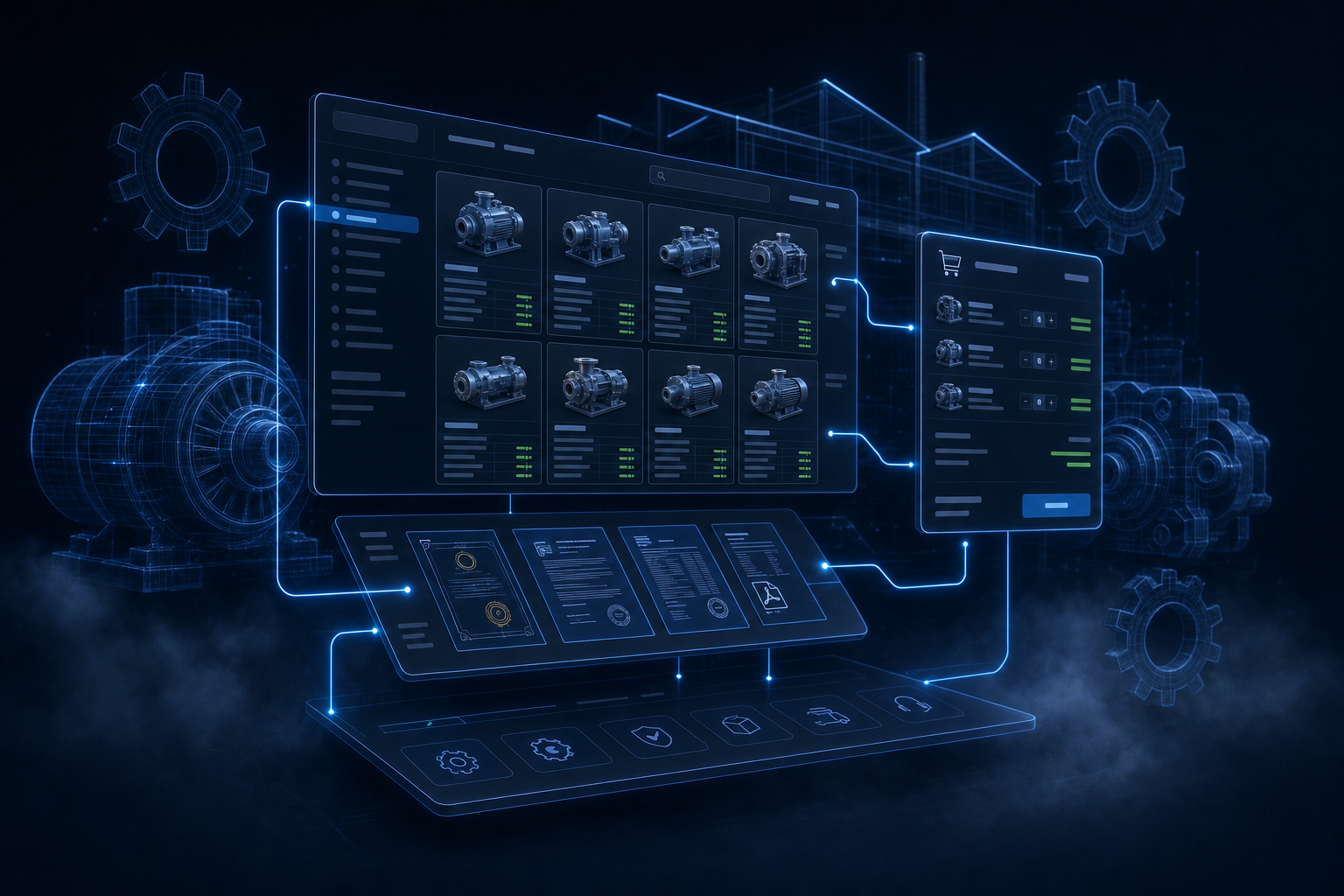
Parameter filters, spec tables, drawings and datasheets — the way an engineer searches
RFQ cart
Collect items → send → receive a quote. No week-long email threads
Documentation
Certificates and standards per item — procurement verifies without asking
Production
Shops, machines, quality control — the section separating a factory from a reseller
Dealer portal
Price lists, stock, marketing materials — partners without calls to managers
Supply cases
Industry, volume, timeline, review — the evidence base for large contracts
How the project runs
How the project runs
- 1-3 days
Brief & estimate
We dig into the task and give a precise price and timeline
- 1-2 weeks
Prototype & design
Structure, mockups and visual sign-off
- 2-6 weeks
Development
Weekly sprint demos — progress is always visible
- 3-5 days
Launch & support
Testing, production deploy, 6-month warranty
A manufacturer’s website is read by engineers — speak their language
The B2B buyer of manufactured goods is a procurement specialist or an engineer with a concrete task. Find an item by specs. Verify standard compliance. Download a drawing. Request a price for a volume. “A wide range of quality products” is noise to them. A manufacturer’s site wins not on beauty but on precision: a structured catalog, complete specs, documentation one click away.
The second specific is the deal cycle. Decisions take weeks and several people. So the site must arm your internal advocate inside the client’s company with everything: specs, certificates, supply cases, production arguments.
A catalog where things get found
The project’s core is the catalog as a tool. Filters by technical parameters, specs in tables, drawings, datasheets and certificates on every item. The procurement specialist finds what’s needed in minutes and verifies compliance without correspondence. The catalog syncs with the ERP: items, prices and stock update automatically. The 80-page PDF becomes history.
There’s a search bonus too. Item and category pages collect low-volume but ultra-targeted demand. Few people search by markings, standards and type sizes, but every one of them buys.
An RFQ in two clicks — and winning on speed
In B2B, response speed wins. The procurement specialist sends the request to several suppliers, and the first quote sets the bar. We install an RFQ cart. Collect the items with volumes, send, and the manager receives a structured request instead of send-me-the-full-price-list. A same-day quote becomes the norm. And that wins contracts from slower competitors.
Production as an argument
The production section is what separates a plant from a reseller in the client’s eyes. Shops, equipment, quality control, capacity and volumes. We add supply cases: the industry, the volume, the timelines, the testimonial. That’s the evidence base for large contracts, where a supplier gets vetted seriously.
Dealers serve themselves
If sales run through partners, the dealer portal takes the help-desk role off the managers. Current price lists, stock, certificates and marketing materials are available to partners on their own. The portal feeds off the same ERP as the catalog, so support needs no extra hands. The freed manager time goes into growing the partner network, not forwarding PDFs.
Related case study
Client reviews
Client reviews
The spec-filtered catalog changed the quality of inquiries. Procurement people arrive with specific items and volumes. Quotes started flying out the same day, and we began winning on speed where we used to lose.
The dealer portal freed managers from the help-desk role. Partners take price lists, stock and certificates themselves. The freed time went into growing the dealer network, and the quarter's numbers show it.
The production section with the shops and QC became our main distinction from resellers in search results. Clients say outright they came to look at the machines. And inquiries appeared from neighboring regions. The site works wider than our geography.
Related solutions
Related solutions
Dental Clinic Website Development
Online booking, doctors, prices and credentials. A website patients trust before their first visit.
E-commerce Website Development
A fast catalog, payments, ERP and shipping sync. A store that works as a sales channel, not a showcase.
Auto Repair Shop Website Development
Online bay booking, prices by make and service pages. A website that books customers while the front desk is busy.
FAQ
FAQ about web development
01How much does a manufacturing company website cost?
A site with the catalog, RFQ requests and documentation starts at $5,000. The price depends on the catalog's volume, the dealer portal and ERP integration. The quote is free after a briefing.
02The catalog is large and lives in the ERP — how do we keep it current?
We integrate the catalog with your ERP. Items, specs, prices and stock sync automatically. Updated in the books — updated on the site, with no manual duplication.
03Does a manufacturer need a cart with online payment?
B2B manufacturing usually needs an RFQ cart, not payment. The procurement specialist collects items, attaches company details and receives a quote. If you have a retail line, we build a hybrid: wholesale through RFQs, retail through payment.
04What does the dealer portal deliver and is it hard to maintain?
Partners take price lists, stock, certificates and materials themselves. Managers stop being a help desk. Maintenance is minimal: the portal feeds off the same ERP as the catalog.
05Can you build an export version?
Yes, multilingual support is designed in architecturally. Language versions of the catalog with unit and currency conversion, export certificates. Our own site runs in two languages on the same scheme.
Let’s discuss your project
Free estimate and a proposed solution within one day.