
Marketplace Integration
Stock without fines, FBS by process and to-the-cent financial reconciliation. A marketplace integration where the system controls the deadlines.
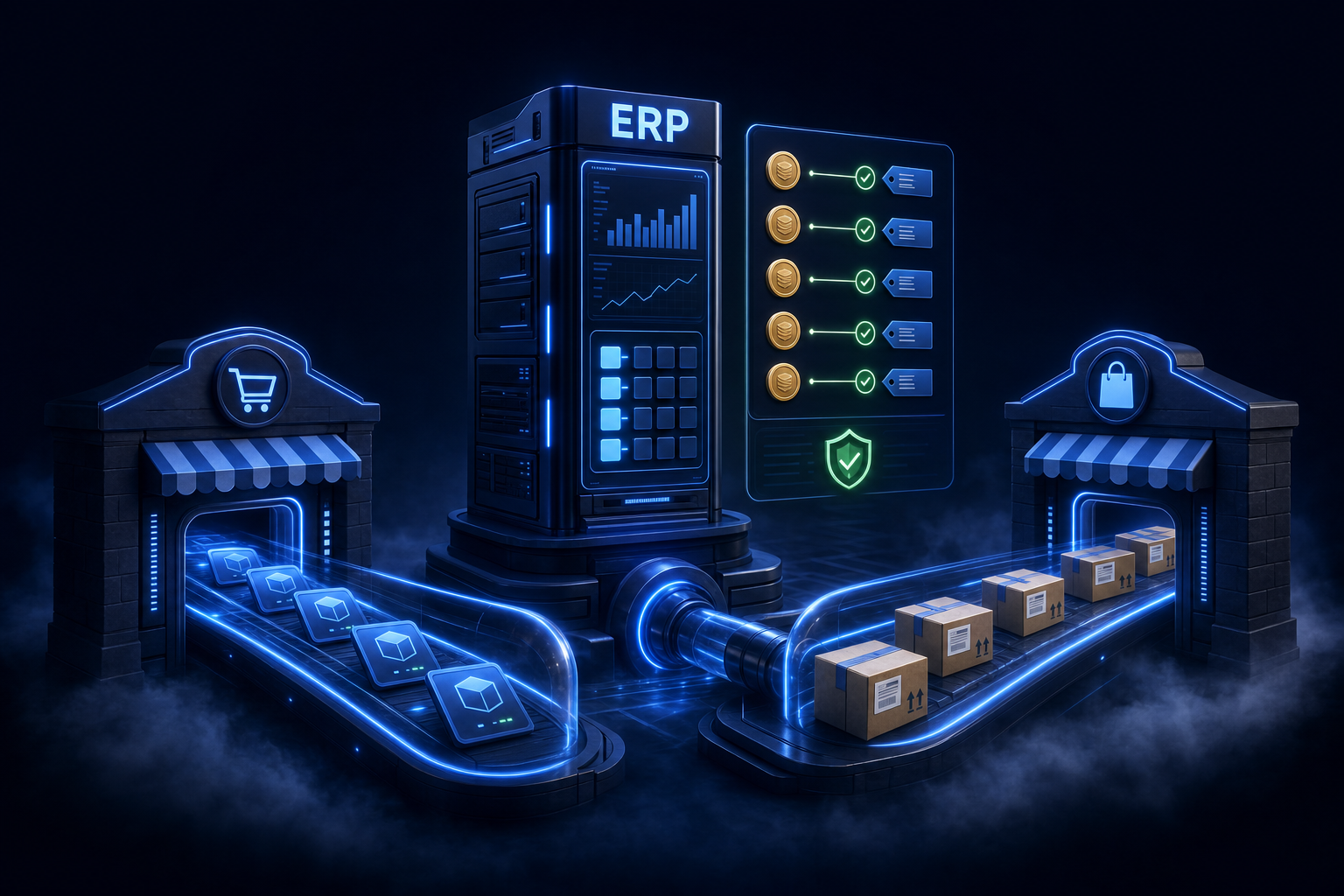
Goals we set for the website
- 0
- penalties for stock cancellations
- 100%
- fulfillment orders in the books automatically
- to the cent
- fee and deduction reconciliation
Sound familiar?
Stock is uploaded to marketplaces by hand: overselling → cancellations → penalties and rating drops
Seller-fulfilled orders are collected from dashboards manually — labels, statuses and deadlines run on an employee's nerves
Marketplace reports don't match the books: fees, logistics, deductions — where the money went is a mystery
Per-SKU unit economics lives in a quarterly spreadsheet — loss-making items sell for months
Marketplace Integration
What's included
Penalty-free stock
Sync with a buffer for in-transit orders — "out of stock" cancellations disappear
Fulfillment orders
New order → ERP document → label → statuses: picking fits the platform's deadlines
Listings & content
Products created from the ERP: attributes, photos, categories — no manual duplication
Finance reconciliation
The platform report unfolds by order: fees and deductions verified against the books
SKU economics
Revenue minus every platform charge per item — loss-makers visible immediately
Prices & promotions
Prices managed from the ERP, auto-promotion control — the platform won't drag you below cost
How the project runs
How the project runs
- 1-2 weeks
Systems analysis
Studying configurations, both APIs, data structures and exchange scenarios
- 1-2 weeks
Exchange design
Data mapping, sync directions and schedule, conflict handling
- 2-6 weeks
Build & testing
Connectors, queues with retries, runs on both systems' staging circuits
- ongoing
Launch & monitoring
Production launch, error alerts, support through system updates
Marketplaces punish manual money management
Marketplaces are an environment of strict regulations. Miss an FBS order’s assembly — a fine. Sell at zero stock — a cancellation, a fine and a rating hit. Miss an auto-promo — you trade at a loss. Manual management of several dashboards is guaranteed to lose to those regulations. The only question is the monthly losses’ size. The accounting integration moves marketplace work from make-it-and-don’t-forget mode into a process where the system controls the deadlines and the stock.
Stock: the main fine source closes first
A sale at zero stock is a seller’s most expensive mistake. A cancellation, a fine, a rating hit, a demotion in the platform’s results. Syncing stock from the ERP with a minutes-level frequency and a buffer for orders in transit closes it architecturally. Prices get managed from the same place. Including protection from the platform’s auto-promos, capable of quietly driving an item into the red.
FBS orders: assembly by process, not on adrenaline
The FBS scheme lives on the platform’s deadlines. An order must be assembled, labeled and handed over on time. The integration runs the full cycle. A new order instantly lands as a document in the books. Labels print in a batch. Statuses go to the platform by the regulation. Reserves link the marketplaces with the other channels. One stock item won’t sell twice between the platform, the site and wholesale.
Finances: to-the-cent reconciliation and honest SKU economics
A marketplace’s report is a puzzle of commissions, logistics, withholdings and compensations that rarely matches expectations. The reconciliation module unfolds the report by order and matches it with the books. Discrepancies get highlighted, the argument with the platform runs on numbers. On top sits the unit economics: every SKU’s margin after all the levies. Losing items stop hiding in the total turnover for months. In the review above, three were found, and removing them from the matrix raised the margin without sales growth.
Multi-account and growth
The circuit scales. Several platforms, accounts and legal entities work in one system with shared stock and separate analytics. Connecting a second platform to a ready circuit is several times cheaper than the first. And if you don’t have your own online store yet, it’s the logical next step with the same product base. We build it and its SEO too. Your own channel lowers the dependence on the platforms’ commissions.
Related case study



Client reviews
Client reviews
Cancellation fines were our permanent expense line: we couldn't keep stock on two platforms current by hand. After the integration, zero fines in half a year. And the store rating grew to excellent for the first time.
The financial reconciliation opened our eyes. The platform withheld more for logistics than we'd assumed, and three items steadily sold at a loss. We removed them from the matrix — the margin grew without sales growth.
FBS orders used to be assembled by a dedicated person with a timer: make the platform's cutoff. Now orders land in the books themselves, labels print in a batch. Assembly runs by process, not on adrenaline.
Related solutions
Related solutions
CRM Platform Integration
Every lead into the pipeline with its source and no duplicates. The site, calls, messengers and the ERP in one circuit around your CRM.
Bitrix24 Integration
Assembling the portal for the company's processes. Lead channels, the ERP, smart processes and the deal-to-project link — Bitrix24 starts working.
Telephony-CRM Integration
A call raises the card, the recording lands in the deal, a missed one becomes a task. The phone stops being sales' black hole.
FAQ
FAQ about integrations
01How much does a marketplace integration cost?
The stock, order and status exchange for one platform — from $4,000, in 4-8 weeks. A second platform in the same circuit is cheaper than the first. The financial reconciliation and unit economics get priced by scope. The quote follows a free audit.
02Which platforms and accounting systems do you work with?
The major marketplaces, added by request. Accounting: ERPs and inventory systems. We work through the platforms' official APIs respecting their limits and regulations.
03Do you support FBS and FBO?
Yes, both schemes. For FBS — the order's full cycle from appearance to shipment with labels and statuses on time. For FBO — supplies, acceptance and stock analytics at the platform's warehouses. Most sellers need the hybrid, we build both circuits.
04How does the financial reconciliation with the platform work?
The platform's financial report unfolds by order and reconciles with the books. Commissions, logistics, fines, compensations. Discrepancies get highlighted in the report. You see where every cent went and argue with the platform armed with numbers.
05What happens at a platform API failure — will orders get lost?
No. The architecture runs on queues with retries, like all our integrations. Orders and stock arrive after recovery, critical failures come as alerts. The platforms' API limits are built into the exchange frequency from the start.
Let’s discuss your project
Free estimate and a proposed solution within one day.