
Furniture Company Website Development
A catalog where a sofa lives in every fabric without a call, a custom-furniture configurator with a price and a measurement request. A website that sells the choice.
Goals we set for the website
- 0
- "check with a manager" in the catalog
- 2 clicks
- to a measurement or estimate request
- 100%
- of prices and stock from the ERP
Sound familiar?
One sofa on the site, forty fabrics in reality — and every variant means "check with a manager"
Custom furniture is sold "price on request": without a price anchor the client leaves for wherever a number exists
Furniture is chosen for weeks by the whole family — and the site can't save and resume the choice
The catalog lives apart from the ERP: on the storefront it exists, in stock it doesn't — and vice versa
Furniture Company Website Development
What's included
The variant catalog
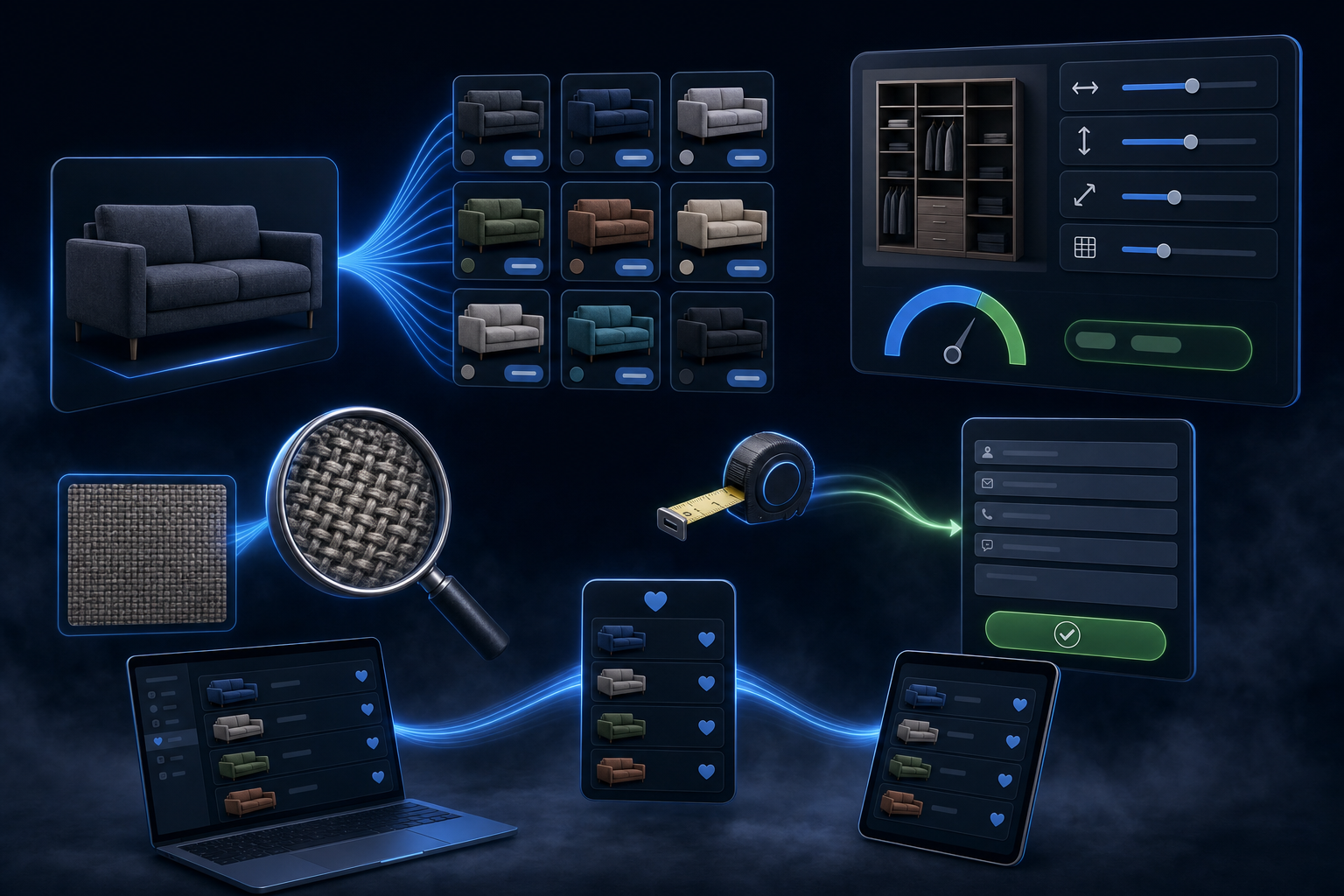
One sofa — forty fabrics and three sizes as priced variants, not "please inquire": the choice happens on the site
The custom configurator
A wardrobe by the niche's dimensions, a kitchen by the floor plan: parameters yield a price anchor — and a request with the estimate attached
The texture storefront
Furniture is bought with eyes and hands: close-up shots, fabric zoom, interior angles, dimension schemes
Measurement & project
"Book a measurer" and "get a design project" — conversions for the long cycle, not just "buy"
Stock from the ERP
Stock, lead times and prices sync with the books: the storefront never promises what isn't there
The long choice
Favorites, comparison, shareable selections — the family chooses for a week and returns to its list
How the project runs
How the project runs
- 1-3 days
Brief & estimate
We dig into the task and give a precise price and timeline
- 1-2 weeks
Prototype & design
Structure, mockups and visual sign-off
- 2-6 weeks
Development
Weekly sprint demos — progress is always visible
- 3-5 days
Launch & support
Testing, production deploy, 6-month warranty
A furniture website sells the choice — or sends it to a competitor
Furniture is a product of variants. One sofa lives in forty fabrics, three sizes and two mechanisms, and people buy a specific combination rather than a sofa in general. A site where all of that is one card with “check with a manager” doesn’t sell. It collects calls from the most patient and loses the rest. We build a storefront where the choice happens on the site: priced variants, texture in close-up, honest ERP stock. In the showroom director’s review, people started arriving with a ready choice. The salesperson closes instead of consulting from zero.
A furniture catalog with variants: fabric, color and size without a call
A furniture catalog is combination math, and it must be designed for it. Item, fabrics, colors and sizes without a flood of duplicate cards. Each variant priced. Filters by material, style and dimensions. Stock and lead times flow from the ERP, so the storefront never promises what the warehouse lacks. Texture is a separate discipline. Furniture is bought with eyes and hands. Close-up shots, fabric zoom, interior angles and dimension schemes belong to the card’s architecture, not to a “we’ll fill it in later”.
Custom furniture: a configurator instead of “price on request”
“On request” is a furniture site’s most expensive text. Without a price anchor the client fears even asking and leaves for wherever a number exists. The configurator breaks the barrier. The client drags a wardrobe’s dimensions to fit their niche, picks kitchen materials for their floor plan and sees the range immediately. The request reaches the manager with the estimate attached. In the manufacturer’s review, requests tripled. And managers stopped computing the same thing ten times, because the estimating routine moved onto the site.
Measurement, favorites and the long cycle: the site carries a weeks-long choice
Furniture is chosen for weeks and by the whole family. The site must handle that. For those still thinking there are long-cycle conversions: book a measurer, get a design project, calculate the cost. Favorites and shareable selections turn the choice into a shared affair. In the store head’s review, the wife builds a list and sends it to the husband, and a third of the orders arrive from those selections. A visitor who didn’t reach the cart isn’t lost. They’re just at their stage.
Integrations, traffic and the combinations
The storefront lives off the books. The ERP feeds stock, prices and production lead times, and manual reconciliation dies as a genre. The store-to-ERP sync case is in the trio below. The SEO structure is built into the architecture: categories, materials and styles catch demand from affordable sofas to custom solid wood kitchens. Nearby sit the store’s mobile app with price-drop pushes, catalog-feed advertising and a CRM for the sales team. The furniture circuit assembles with one vendor.
Related case study


Client reviews
Client reviews
The configurator removed custom furniture's main barrier, the fear of too-expensive-to-even-ask. The client drags the dimensions, sees the range and files a request with the estimate attached. Three times the requests. And managers no longer compute the same thing ten times over.
The site used to hold one sofa from $600 while forty fabrics lived in a manager's head. Now every variant has a price and a photo. People arrive at the showroom with a ready choice, this one in this weave. Salespeople close instead of consulting from zero.
Shareable favorites looked like a minor feature and became a working mechanic. The wife builds a list, sends it to the husband, they choose together in the evening. A third of the orders arrive from those selections.
Related solutions
Related solutions
Dental Clinic Website Development
Online booking, doctors, prices and credentials. A website patients trust before their first visit.
E-commerce Website Development
A fast catalog, payments, ERP and shipping sync. A store that works as a sales channel, not a showcase.
Auto Repair Shop Website Development
Online bay booking, prices by make and service pages. A website that books customers while the front desk is busy.
FAQ
FAQ about web development
01How much does a furniture company website cost?
From $5,000 for 5-8 weeks. That covers the variant catalog, texture-rich cards, measurement requests and ERP integration. A custom configurator is priced separately by its logic's complexity. The quote follows a free assortment review.
02Why variants if everything we make is custom?
That's exactly why. Custom without a price anchor scares, and the client leaves for wherever a number exists. Variants and the configurator give a range before the call. The person estimates the budget themselves and files a request already prepared. In the manufacturer's review, requests tripled after precisely this.
03Will the catalog hold our assortment — thousands of items with fabrics?
Yes. The catalog is designed for furniture math: item, fabrics, colors, sizes and mechanisms without duplicate cards. Filters by material, style, size and price. Stock and lead times flow from the ERP. Thousands of SKUs are the normal mode, the store case sits in the trio below.
04What matters more for furniture — photos or 3D?
Honestly, good photography decides more. Close-up texture shots, fabric zoom, interior angles and dimension schemes close 90% of the choice questions. 3D and AR try-ons are amplifiers for flagship collections. Add them after the base storefront works, not instead of it.
05Will you help with traffic after launch?
Yes. The SEO structure is laid in from the start: categories, materials and styles catch queries like scandinavian sofas or solid wood kitchens. Then promotion and catalog-feed advertising join. Furniture is a long-choice niche, and the storefront-plus-nurturing pair wins here.
Let’s discuss your project
Free estimate and a proposed solution within one day.