
CRM for Transport and Logistics Companies
The order, the trip, the driver and the money in one circuit. A logistics CRM: the dispatcher sees every truck, the client sees their cargo, the director sees the trip's margin.
Goals we set for the website
- 100%
- of orders and trips in the system
- −70%
- where-is-the-cargo calls
- 1 day
- from unloading to the invoice
Sound familiar?
Orders live in logisticians' phones: a lost call is a lost trip, a departed logistician takes the base
Where the truck and cargo are, only the driver knows: the client calls dispatch, dispatch calls the driver
A trip's margin is a mystery until month-end: the client's rate minus all costs computes nowhere
Documents are scattered: orders, contracts, waybills — invoices go out weeks late
CRM for Transport and Logistics Companies
What's included
The order funnel
Calls, email, boards and the site into one queue: rate calculation, approval, not a single order sinks
The dispatch board
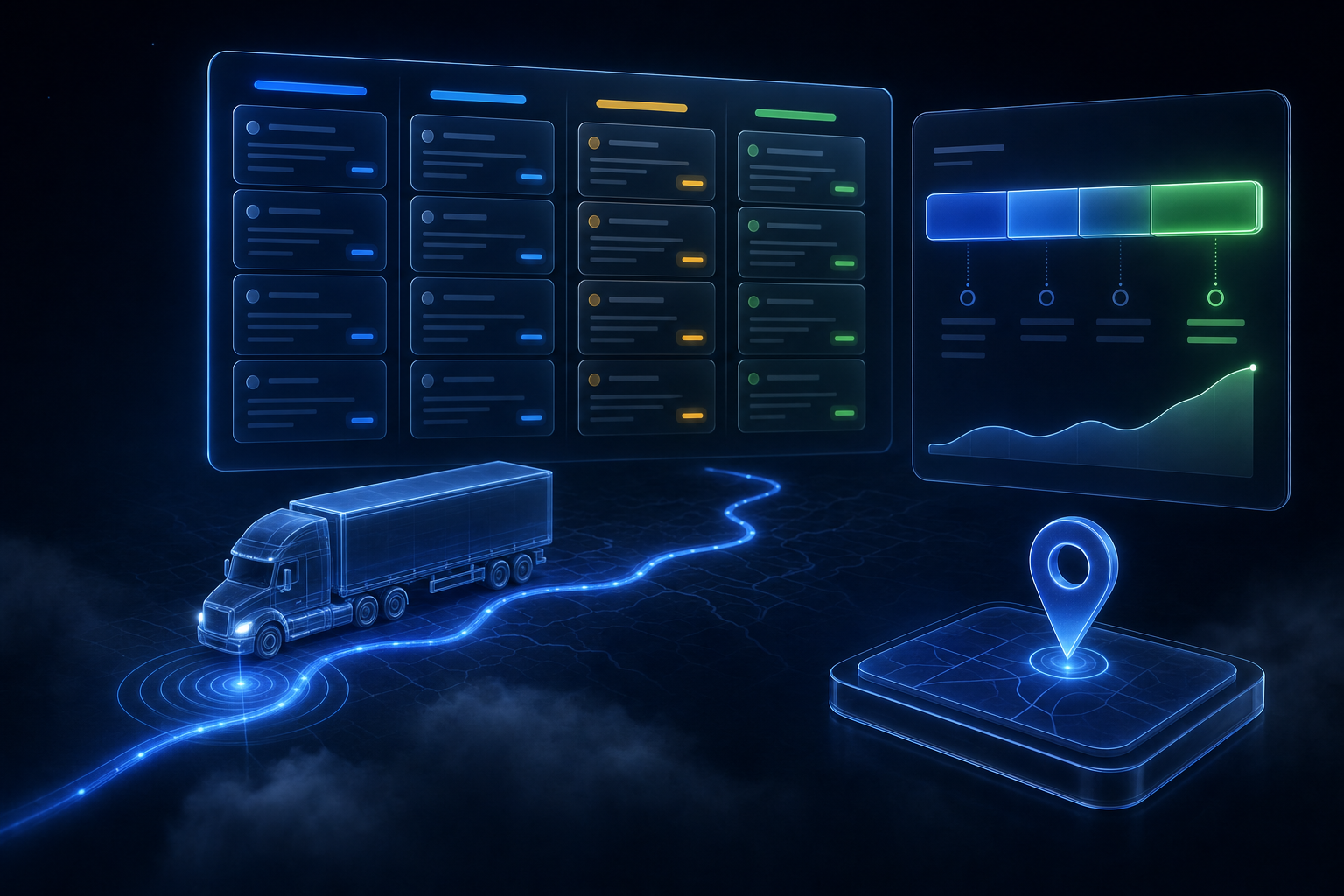
The trip board: statuses, trucks, drivers, troubled ones highlighted — the shift on one screen
The trip's margin
The rate minus fuel, wages, tolls, subcontractors: every trip's profit visible at closing
The client portal
Cargo status, documents, shipment history: where-is-the-truck stops being a call
Documents by chain
Waybills from the trip's data, the invoice at unloading: receivables don't grow over paperwork
Carriers
The subcontractor base: rates, reliability, documents, settlements — a truck found in minutes
How the project runs
How the project runs
- 1-2 weeks
Process audit
How the business really runs: bookings, sales, accounting, bottlenecks
- 2-3 weeks
System design
Architecture, role scenarios, data migration and integration plan
- 4-10 weeks
Build & configure
System assembly, integrations, data transfer — alongside the old process
- 1-2 weeks
Launch & training
Team training, playbooks, staged rollout and launch support
Logistics without a system is a dispatcher holding the company in their head
While trips are few, logistics runs on the dispatcher’s memory and the logistician’s phone. Growth breaks that model predictably: orders get lost between calls, where-is-the-truck eats half the day, a trip’s margin surfaces at month-end, documents chase the unloading for weeks. The CRM moves the operations into a system: the order → the calculation → the trip → the documents → the money, in one circuit. In our transport case, profit grew 20% with the same fleet — simply because the margin became visible.
The order funnel: the base belongs to the company, not logisticians’ phones
Orders come from everywhere: calls, email, load boards, the site. The CRM gathers them into one queue with the source and the client. The rate calculation — by route, tonnage and body type — runs in the card, the approval gets fixed in writing. A lost call stops being a lost trip. And the client base with history and rates belongs to the company: a departing logistician takes only experience.
The dispatch board and the margin: the shift on one screen, profit on every trip
The trip board shows the whole shift: statuses from loading to unloading, trucks and drivers, troubled trips highlighted. The driver moves statuses from the phone in two taps. The economics computes in parallel: the client’s rate minus fuel, wages, tolls, the subcontractor. In the owner’s review, the visible margin exposed the nearly-zero routes — the rate rebuild gave +20% profit without a single new truck.
The client portal: where-is-the-cargo stops being a call
Half of dispatch’s inbound is where-is-my-truck. The client portal answers without people: the trip’s status, GPS coordinates, documents, shipment history. In the dispatch head’s review, fifty daily calls turned into a link. For the client it’s national-carrier-grade service. For you it’s dispatchers working the trips, not the reference desk.
Documents, carriers and integrations
The document chain assembles from the trip’s data: the order, the contract, the waybill, the invoice and the act — without retyping. The invoice goes out on the day of unloading, and receivables stop growing over paperwork. The subcontractor base holds rates, documents and reliability: finding a truck for a trip takes minutes. Integrations close the circuit: the ERP, GPS tracking, telephony, load boards. Nearby sit the logistics rollout case and transport SEO — the stack assembles with one vendor.
Related case study

Client reviews
Client reviews
The trip's margin became visible — and a third of our favorite routes turned out nearly zero. We rebuilt the rates and dropped the loss-making clients. Profit grew 20% with the same fleet. We simply couldn't see it before.
The client portal unloaded the dispatchers radically. Where-is-the-truck used to ring fifty times a day, now the client checks the status by link themselves. Dispatchers work the trips, not the information desk.
An invoice on the day of unloading is a small revolution. Documents used to gather for weeks, and receivables grew out of thin air. Now the waybill and the invoice form from the trip automatically. The cash gap shrank tangibly.
Related solutions
Related solutions
CRM for Beauty Salons
Your own system instead of an eternal subscription. Booking, the base, stylists' pay and client returns built for your chain's processes.
CRM for Auto Repair Shops
A digital work order, per-VIN history and parts without black holes. A CRM where every repair and every dollar leaves a trace.
ERP for Manufacturing
Machine and crew planning, an honest cost price before the order launches and materials without eyeball reserves. Manufacturing that is managed, not firefought.
FAQ
FAQ about crm/erp systems
01How much does a transport company CRM cost?
From $10,000, rollout in 10-16 weeks. That covers orders with calculations, trips, the client portal, document flow, the trip's margin and settlements. The range depends on the fleet's size, the subcontracted share and the integrations. The quote follows a free process audit.
02We run our own fleet plus subcontractors — will the system hold both?
Yes, that's typical logistics. The own fleet runs with drivers, maintenance and costs. Subcontractors run as a carrier base with rates, documents and a reliability history. The trip's margin computes correctly in both schemes: the client's rate minus the actual execution's costs.
03How is the trip's margin computed?
The trip's costs subtract from the client's rate: fuel by norm or fact, the driver's wages, tolls, the subcontractor's rate, other expenses. Profit shows at the trip's closing, not month-end. In the review above that lifted profit 20% without fleet growth — by dropping the loss-making.
04Do you integrate with GPS tracking and the ERP?
Yes. GPS tracking feeds live coordinates into the trip's card and the client portal. The ERP receives invoices and acts, returns payments. Telephony raises the client's card on a call. Load boards feed orders into the shared funnel. Integrations are our profile.
05Will the drivers cope with the system?
The driver gets the minimum: a mobile interface with loaded/unloaded statuses, document photos from the phone, the route. No twenty-field forms. The statuses move the trip and the client portal automatically. Training takes half an hour.
Let’s discuss your project
Free estimate and a proposed solution within one day.