
Inventory System Integration
Live stock and prices on the site, orders with statuses and reserves. Selling what isn't in the warehouse becomes impossible.
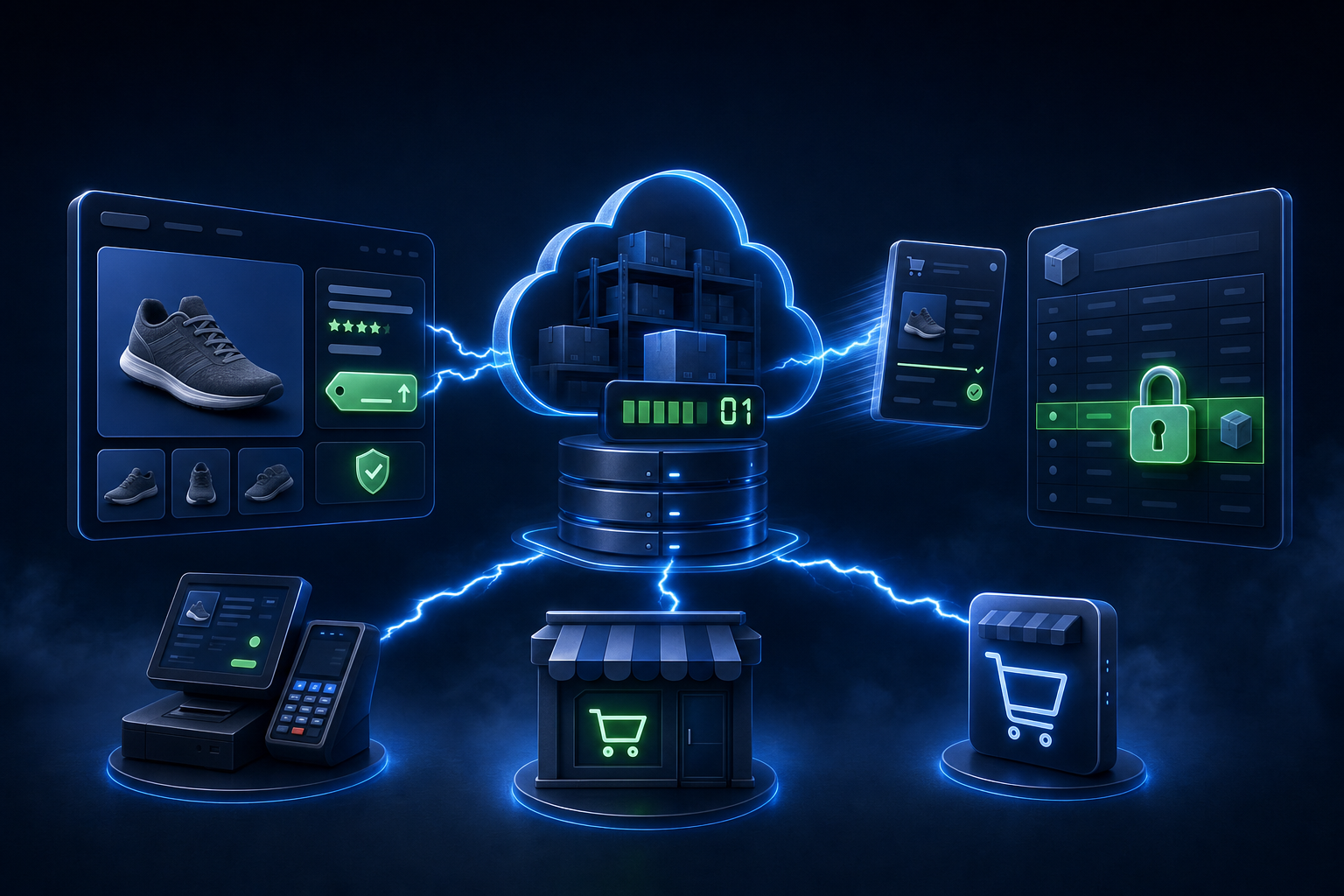
Goals we set for the website
- 0
- sales of absent goods
- seconds
- from warehouse to storefront
- 1 stock
- pool across all channels
Sound familiar?
Website stock lives its own life: you sold what's gone — apologies and refunds
Prices change in the inventory system while the site shows old ones — margin lost on every order
Website orders are retyped into the books by hand: a manager's evening and line-item errors
The site, retail and marketplaces sell one warehouse blindly — double-selling the last unit
Inventory System Integration
What's included
Catalog sync
Products, variants, photos and attributes — from the inventory system to the storefront without duplication
Live stock
Warehouse movements change site availability in seconds — "out of stock" is honest
Prices & promos
Price types and discounts flow to the storefront: margin controlled by the books
Orders & statuses
A site order lands in the system with items and the customer; processing statuses show to the buyer
Reservation
A paid order books the stock — retail and marketplaces can't sell the same unit
The webhook circuit
Event-driven exchange instead of an hourly sync: the speed e-commerce lives at
How the project runs
How the project runs
- 1-2 weeks
Systems analysis
Studying configurations, both APIs, data structures and exchange scenarios
- 1-2 weeks
Exchange design
Data mapping, sync directions and schedule, conflict handling
- 2-6 weeks
Build & testing
Connectors, queues with retries, runs on both systems' staging circuits
- ongoing
Launch & monitoring
Production launch, error alerts, support through system updates
The site and the warehouse must be one system — otherwise you sell blind
While the storefront and the books live apart, the store trades by guesswork. Site stock goes stale within hours. Prices diverge from the books. Orders get moved by hand. Every gap is money. Selling the absent means a return and lost trust. A stale price means lost margin. Manual transfer means a manager’s evening and mistakes. The inventory integration stitches the circuit. The warehouse drives the storefront, the storefront creates orders in the books. In real time, without people on the handoff.
Live stock: in-stock becomes honest
A warehouse movement — a retail sale, a receipt, a write-off — reaches the storefront by webhook within seconds. An item ran out — the card honestly shows out-of-stock or hides. A supply arrived — the item returned to sale by itself. In the parts store owner’s review, the chronic sold-air pain closed fully. Half a year without a single apology to a client. For a store that’s not comfort. That’s reputation.
Orders and reserves: the end of manual transfer and double sales
A site order gets created in the inventory system automatically, with line items, the client and the sum. Processing statuses fly back to the buyer. The manager stops being the human integration — in the brand director’s review, “paid off in a season”. Reserves close the second classic. A paid order books the stock, and retail with the marketplaces physically can’t sell the same last unit. Multichannel trade from one warehouse turns from a roulette into a system.
Prices, promos and a catalog without duplicates
The inventory system’s price types drive the storefront. Retail, promo, wholesale — the books decide which shows where, and the margin stays under control. The catalog is kept once. Products, variants — sizes, colors, — photos and attributes go to the site without manual duplication. Discounts and promos launch in the books. The storefront picks them up itself.
Scope, timing and the combinations
The basic circuit launches in 2-5 weeks. An audit of your scheme → entity mapping → the webhook exchange → tests on live scenarios. A custom integration is built for your model, not an out-of-the-box plugin. Bundles, several warehouses, your own reserve logic. Adjacent solutions sit nearby. The ERP sync for those on it, the case in the trio. The payment circuit with receipts. Turnkey online stores. The whole e-commerce stack with one vendor.
Related case study


Client reviews
Client reviews
Selling air was our chronic pain. An item left in retail, and the site took an order for the same one. Reserves and live stock closed the question fully: half a year without a single apology to a client.
A manager spent evenings moving site orders into the inventory system by hand, with mistakes in sizes and SKUs. Now orders land themselves with line items and the client, and she works with buyers. It paid off in the very first season.
We sell on the site and two marketplaces from one warehouse. It used to be a roulette of double sales. A single stock with reserves turned the roulette into a system: the marketplaces see honest availability.
Related solutions
Related solutions
CRM Platform Integration
Every lead into the pipeline with its source and no duplicates. The site, calls, messengers and the ERP in one circuit around your CRM.
Bitrix24 Integration
Assembling the portal for the company's processes. Lead channels, the ERP, smart processes and the deal-to-project link — Bitrix24 starts working.
Marketplace Integration
Stock without fines, FBS by process and to-the-cent financial reconciliation. A marketplace integration where the system controls the deadlines.
FAQ
FAQ about integrations
01How much does an inventory system integration cost?
The basic circuit — the catalog, stock, prices, orders — from $2,500 in 2-5 weeks. Reserves, marketplaces and non-standard scenarios affect the quote. The audit of your setup and the estimate are free.
02Which site platforms do you work with?
Any. Popular CMSs, custom-built stores, our own builds. The integration runs through the inventory system's API, and on the site's side we adapt to your platform. If we build the store, the circuit is laid in from day one.
03Why is this better than off-the-shelf sync modules?
Off-the-shelf modules are fine in typical scenarios and break on your specifics. Variants, bundles, price types, reserve logic, several warehouses. A custom integration is built for your model and doesn't force the business to fit a plugin's limits.
04How fast does the stock update?
Through webhooks, by events. A retail sale or a warehouse receipt changes the storefront within seconds, not at-the-next-hourly-sync. For e-commerce with live traffic that's the difference between an honest in-stock and apologies.
05We also run a retail point and marketplaces — will you cover that?
That's the typical scenario, and we build it right. One stock for all channels, reserves on paid orders, honest availability on the marketplaces. A double sale of the last unit is excluded by architecture.
Let’s discuss your project
Free estimate and a proposed solution within one day.