
MVP App Development
A scope session with metrics, the core in 8-12 weeks and analytics from day one. An MVP that answers the hypothesis instead of eating the budget.
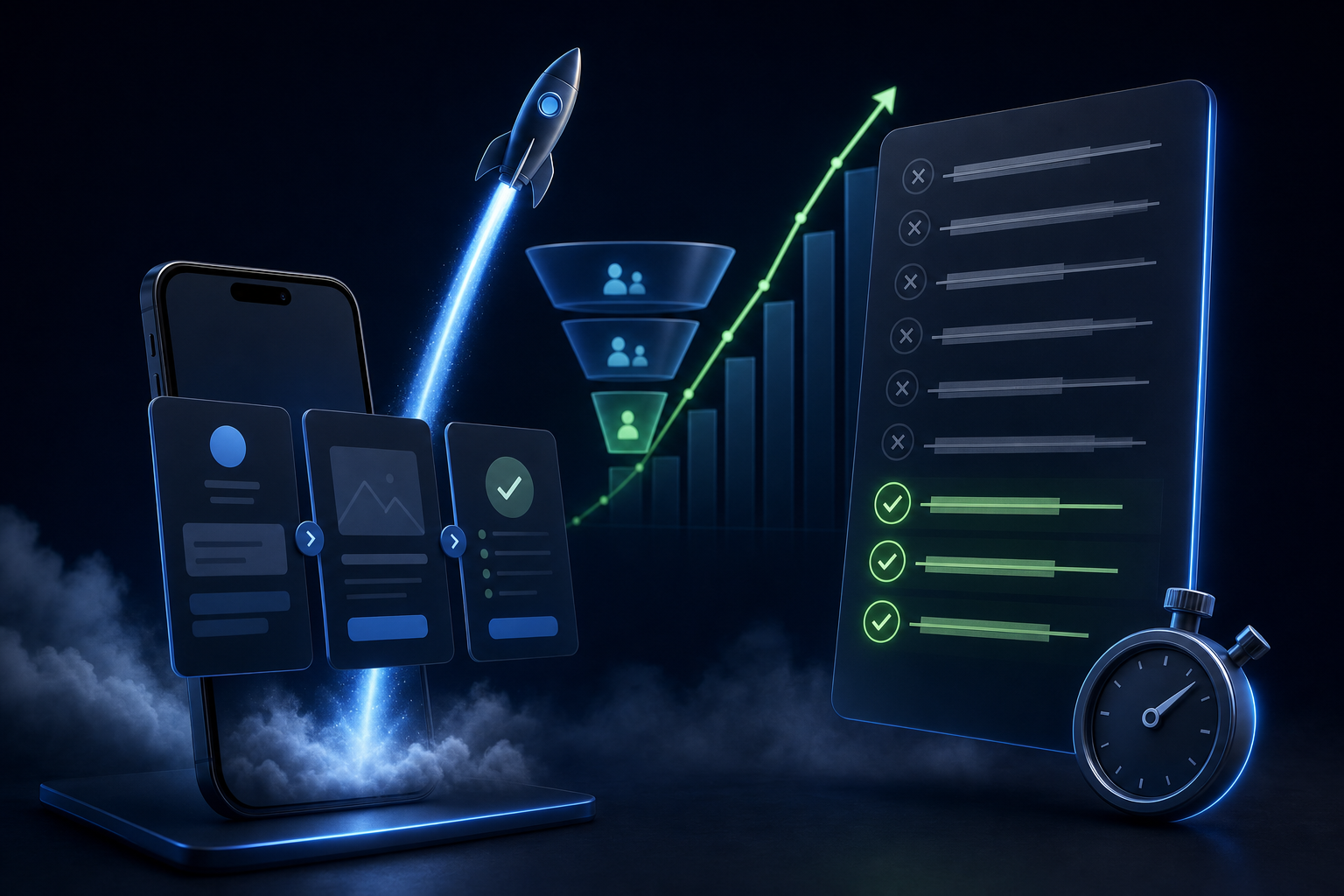
Goals we set for the website
- 8-12
- weeks to a product in stores
- 1
- codebase for both platforms
- 100%
- of v2 decisions on data, not opinions
Sound familiar?
The idea exists, the investor asks for traction — and there's nothing to show but a deck
Agencies quote a "full app" at a year and a fortune — absurd for testing a hypothesis
Freelancer friends built an "MVP" that collapsed on the first users
Cutting features feels terrifying: without each one the product seems "not it"
MVP App Development
What's included
Scope & metrics
The hypothesis and success criteria defined before the start — an MVP without a metric is just a small app
A one-week prototype
Clickable screens before a line of code: the first user insights nearly free
The product core
One value scenario done properly — instead of ten done halfway
Analytics & events
The funnel, retention, drop-off points — post-launch decisions belong to data
Stores turnkey
Accounts, materials, privacy, review — rejections are our problem
A foundation to grow
Clean architecture and code: v2 builds on top, and the repo survives investor scrutiny
How the project runs
How the project runs
- 1-2 weeks
Discovery & prototype
User flows, a clickable prototype, an estimate and release plan
- 2-3 weeks
UI design
Screens per iOS and Android guidelines, the app design system
- 6-14 weeks
Build & testing
Sprints with demo builds every two weeks; backend and integrations in parallel
- ongoing
Release & growth
App Store and Google Play publication, monitoring, metric-driven updates
An MVP is a testing instrument, not a small app
An MVP’s job is to answer do-people-need-this-product with minimal money and time. Everything else follows. The scope gets cut to the value core. Success metrics get phrased before the start. Analytics stands up from day one. If the MVP doesn’t answer the hypothesis’s question, it’s not an MVP but a small app that ate the budget. Our scope session starts exactly there. What we’re testing and by which numbers we’ll read the result.
Cutting hurts — and it’s the most valuable part of the work
A founder arrives with a feature list of dozens of items, and each seems indispensable. Our launch experience says the opposite. Users will ask to bring back two or three of the cut ones, the rest would’ve been paid ballast. We help cut structurally. The hypothesis → the main scenario → the minimum that supports it. What never gets cut: security, stability, analytics and the core’s UX. Crooked execution fails the idea’s test, not the idea itself.
Speed without crutches: scope instead of shortcuts
8-12 weeks to the stores are reached by scope discipline, not by cutting corners in code. The difference is principal over the distance. A crutch-built MVP falls apart at the first hundreds of users and gets rewritten from scratch, along with the trust of an investor looking into the repository. Our foundation — Flutter with one codebase, clean architecture, documentation — survives pivots and builds up to v2 without demolition. Tech due diligence passes calmly.
Analytics: after launch, data drives the product
An MVP’s launch is the work’s beginning, not its finale. From there, what the numbers show decides. We lay product analytics from day one. Events along the main scenario, the funnel, retention, drop-off points. In a month or two the founder has the material for a decision: scale, pivot or close the hypothesis with little blood. All three outcomes are the MVP’s success. It exists precisely for that answer.
The launch and what’s next
The process: a scope session with metrics → a clickable prototype, the first insights before code → sprint development with demos → turnkey store publication. After launch come development sprints. The v2 backlog gets prioritized by data with the same team. And when the hypothesis is confirmed and a full product is needed, we already know it from inside. From e-commerce and delivery to corporate circuits — see the neighboring mobile solutions.
Related case study


Client reviews
Client reviews
I came with a 40-item feature list, we went into development with seven. Cutting hurt, but exactly that saved us. Launched in 10 weeks, and the data showed: of the 33 cut features, users asked for two. The rest I'd have paid for in vain.
Our MVP was built by some-guys-we-knew — it fell apart at three hundred users, the investor looked at the code and winced. Here it got rebuilt in 9 weeks. The product holds the load, and due diligence passed with no questions to the tech.
Day-one analytics gave the most. Within a month we saw the funnel and the drop-off point, and pivoted on numbers, not intuition. We built the second version on the same foundation, throwing nothing away.
Related solutions
Related solutions
Food Delivery App Development
A client app plus a courier circuit. A one-minute order, map tracking and pushes instead of retargeting. Your own channel instead of aggregator commissions.
Beauty Salon App Development
A two-tap booking with a specific stylist, pushes against no-shows and points instead of a stamped card. A salon app that brings clients back.
E-commerce Mobile App Development
One-tap checkout, pushes instead of expensive retargeting and the catalog from the same ERP. The app as the repeat-purchase channel.
FAQ
FAQ about mobile development
01How much does a mobile app MVP cost?
From $9,000 for 8-12 weeks. That covers the product core, analytics and store publication. The price depends on the number of scenarios and the backend needs. After the scope session we give a fixed quote. For an MVP that's principal: the hypothesis-testing budget must be predictable.
02How does an MVP differ from a cheap app?
In focus and core quality. An MVP is one value scenario done well, plus analytics to test the hypothesis. A cheap app is ten scenarios done sloppily. The first gives data for decisions and a foundation for v2. The second gives only costs and technical debt.
03What gets cut, and what can't be?
We cut everything that doesn't test the hypothesis: for-the-future dashboards, settings, secondary scenarios. We don't cut security, core stability, analytics and a decent UX of the main scenario. A crooked core fails the idea's test, not the idea.
04Won't the MVP have to be thrown away at growth?
Not if the foundation is laid right, and that's our principle. Clean architecture, documented code, separated layers. V2 gets built on top of the proven core. What gets thrown away is usually MVPs assembled on crutches for speed. We reach the same speed with scope, not crutches.
05Will you help with data-driven development after launch?
Yes, that's the second half of the value. We look at funnels and retention together, prioritize the v2 backlog by numbers rather than a year-old feature list. The format is development sprints with the same team that knows the product.
Let’s discuss your project
Free estimate and a proposed solution within one day.