
Inter-Agency Data Exchange Integration
Registry lookups in minutes instead of official letters in weeks. A signed-message adapter, automated failure handling and the certification route walked for you.

Goals we set for the website
- minutes
- per inter-agency lookup instead of weeks
- 100%
- of the exchange logged with evidence
- 1 attempt
- to pass certification — the route's goal
Sound familiar?
Certificates from other agencies are requested by official letters — the citizen waits weeks for what the exchange returns in minutes
Exchange formats, protocols and regulations are a dark forest: the in-house developer drowns in approvals
Onboarding stalls for months: applications bounce back, testing fails, the contract deadline burns
A vendor delivered "request sending" — while failures, retries and statuses are sorted by an operator by hand
Inter-Agency Data Exchange Integration
What's included
Lookup registry
The agency's outbound requests are mapped to exchange services: what to connect, in what order and why
The exchange adapter
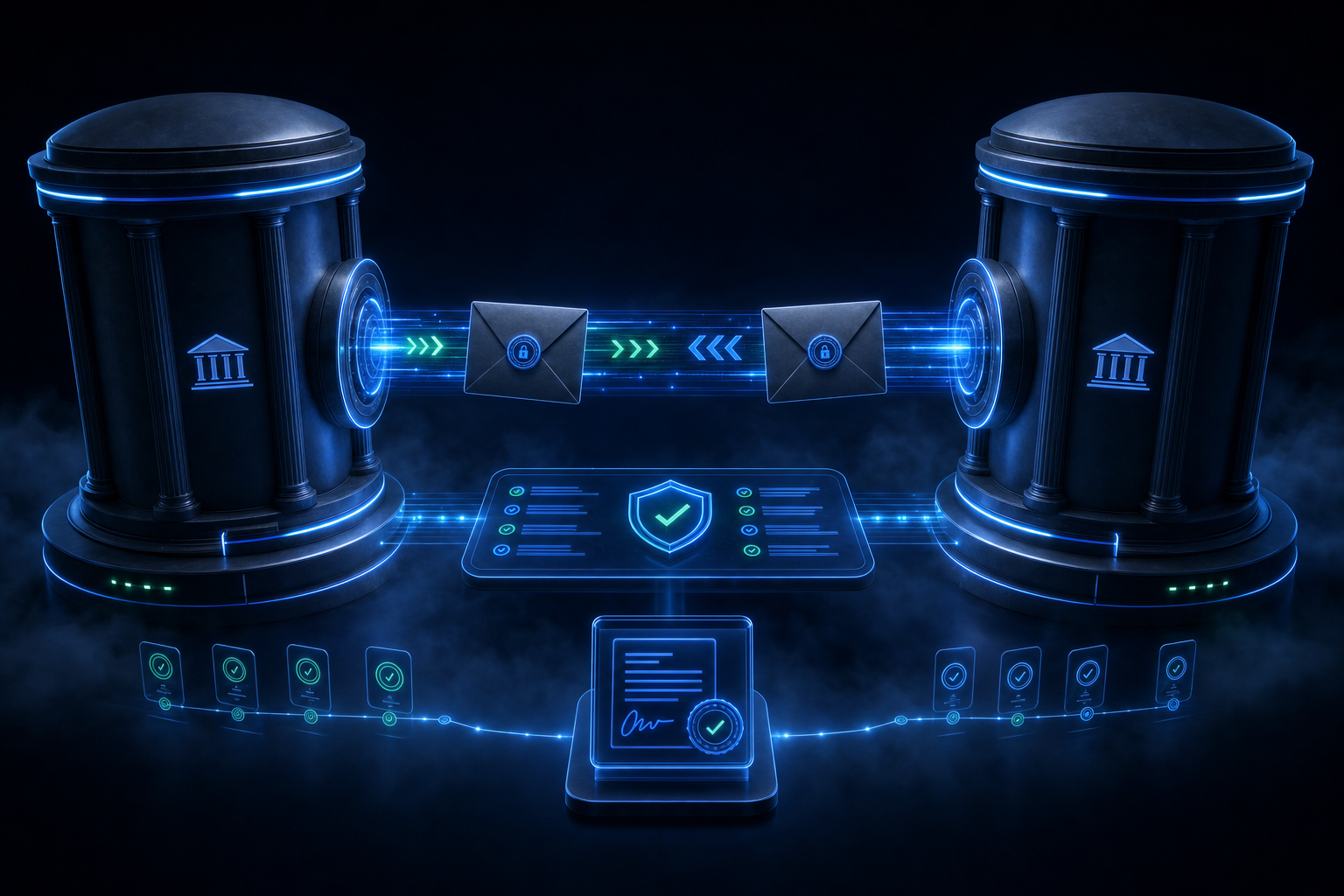
Signing, dispatch, queues and statuses — the integration runs itself, without an operator at the console
Failure sorting
Error codes and format rejections are handled automatically: a retry, an escalation or a clear reply to the applicant
The exchange log
A complete history of requests and responses: any "the agency never replied" dispute closes with an extract
Test → production
The test environment, protocols, the operator's acceptance — a rollout route we've walked repeatedly
Regulatory upkeep
Exchange formats evolve — the adapter evolves with them instead of breaking silently
How the project runs
How the project runs
- 1-3 days
Brief & estimate
We dig into the task and give a precise price and timeline
- 1-2 weeks
Prototype & design
Structure, mockups and visual sign-off
- 2-6 weeks
Development
Weekly sprint demos — progress is always visible
- 3-5 days
Launch & support
Testing, production deploy, 6-month warranty
An inter-agency integration is a regulation, not just an API
The technical docking is the smaller half of the work. The exchange’s real complexity is the route. Service registries, connection applications, questionnaires, regulator approvals, the test environment, the operator’s acceptance. Self-managed teams stall here for months, bouncing applications in circles. We walk the route regularly and know the typical rejection causes. In the project lead’s review, half a year of solo attempts turned into two months to production. The problem isn’t a complex exchange. It’s knowing the road.
Connecting registry lookups: from a request inventory to a plan
The integration starts not with code but with an inventory. Which data the agency requests today by letters and calls. Which exchange services cover them. What to connect first by the effect on citizens and service timelines. That yields a connection plan with clear economics per lookup. In the IT head’s review, a certificate that took two to three weeks by letter started arriving in minutes. The whole service moved online.
The exchange adapter: queues, statuses and failure sorting
Sending a request is not an integration. A live exchange means message signing, queues, statuses and retries on outages. Above all, it means failures. Format errors, rejection codes, stuck responses. If an operator sorts them by hand, the integration created work instead of removing it. Our adapter sorts failures itself: a retry, an escalation or a clear reply to the applicant. In the IT director’s review, up to a hundred errors a week moved off the operator onto the system. Every request and response sits in the log with an evidentiary history.
The test environment and the production rollout
Between “works on our side” and “works in the exchange” lies the test environment. Scenarios, protocols, the operator’s remarks, acceptance. It’s a separate stage with its own rules, and it gets failed more often than the development itself. We plan testing as a full phase. Scenarios are prepared per lookup, protocols are written alongside the work rather than after the fact. The route’s goal is passing on the first attempt.
Upkeep of the integration, and the combinations
Exchange formats and regulations keep evolving. An unattended integration breaks silently and surfaces through complaints. Regulatory upkeep keeps the adapter current: changes are tracked, updates ship ahead of time, the log stays under watch. Nearby sits the rest of the government circuit. The government portal with online services, where the exchange is a native part. The procurement-compliant website. The state-systems cases in the selection below. The government stack assembles with a vendor who has walked these routes.
Related case study


Client reviews
Client reviews
Before the integration, debt certificates were requested by official letters. Two to three weeks of waiting. Through the exchange the answer arrives in minutes, and a service people took a day off for moved fully online.
We wrestled with onboarding for half a year. Applications bounced, tests failed. This team took the regulator correspondence onto themselves, and two months later we were in production. The problem wasn't a complex exchange. It was knowing the route.
The previous vendor delivered request sending, and our operator sorted the failures by hand. Up to a hundred a week. The new adapter sorts them itself: retries, escalations, the log. The operator finally does something more useful than forwarding errors.
Related solutions
Related solutions
Government Contract Website Development
Websites and portals under government contracts. Strict spec compliance, security requirements, standards-grade documentation and acceptance without nerves.
Government Portal Development
National-ID sign-on, e-services with statuses and an architecture sized for the peak day. A portal that passes acceptance on the first attempt.
Government Organization Website Development
Disclosure without remarks, standards-grade accessibility and clear services for citizens. A government organization website that passes inspections and serves people.
FAQ
FAQ about government contracts
01How much does an inter-agency exchange integration cost?
From $12,000 for 8-14 weeks. That covers the adapter, the agreed registry lookups, failure handling, the log and certification passage. The range depends on the number of lookups and the state of your system. The quote follows a free task analysis.
02Why does onboarding take weeks rather than days?
Technical work is less than half of it. The rest is the regulatory route: applications, questionnaires, approvals, the test environment, the operator's acceptance. Code can't speed it up, but you can avoid stalling. We know the typical rejection causes and pass the route on the first attempt. In the review above, half a year of solo attempts turned into two months.
03Do you take over the correspondence with the exchange operator?
Yes, it's part of the service. Connection applications, questionnaires, replies to remarks, test scheduling. The agency signs the documents, we walk the route. Approvals are exactly where self-managed onboardings drown.
04What do you need from our information system?
An integration surface: an API, or database access for the adapter to dock with. If the system is legacy or closed, we build the adapter as a separate circuit beside it, with minimal intrusion. At the analysis we'll say honestly which option is cheaper and more reliable in your case.
05What happens when exchange formats get updated?
Formats and regulations keep evolving. An unattended exchange breaks silently and surfaces through citizens' complaints. So we offer regulatory upkeep: we track the changes, update the adapter ahead of time and keep the log under watch. An integration isn't delivered-and-forgotten, and we say so at the start.
Let’s discuss your project
Free estimate and a proposed solution within one day.