
Shipping Carrier Integration
Exact cost and dates right in the cart, pickup points on a map and waybills without manual entry. Delivery stops killing conversion and eating the manager's day.
Goals we set for the website
- +10-20%
- cart conversion with exact pricing
- minutes
- for dispatch instead of half an hour per order
- −70%
- "where's my order" tickets
Sound familiar?
"The manager will confirm the shipping cost" — and the cart is abandoned: uncertainty kills the order
Waybills are filled by hand: half the manager's day and address errors
"Where's my order?" is support's top question, because tracking lives elsewhere
Every new carrier means a new dashboard and a new manual process
Shipping Carrier Integration
What's included
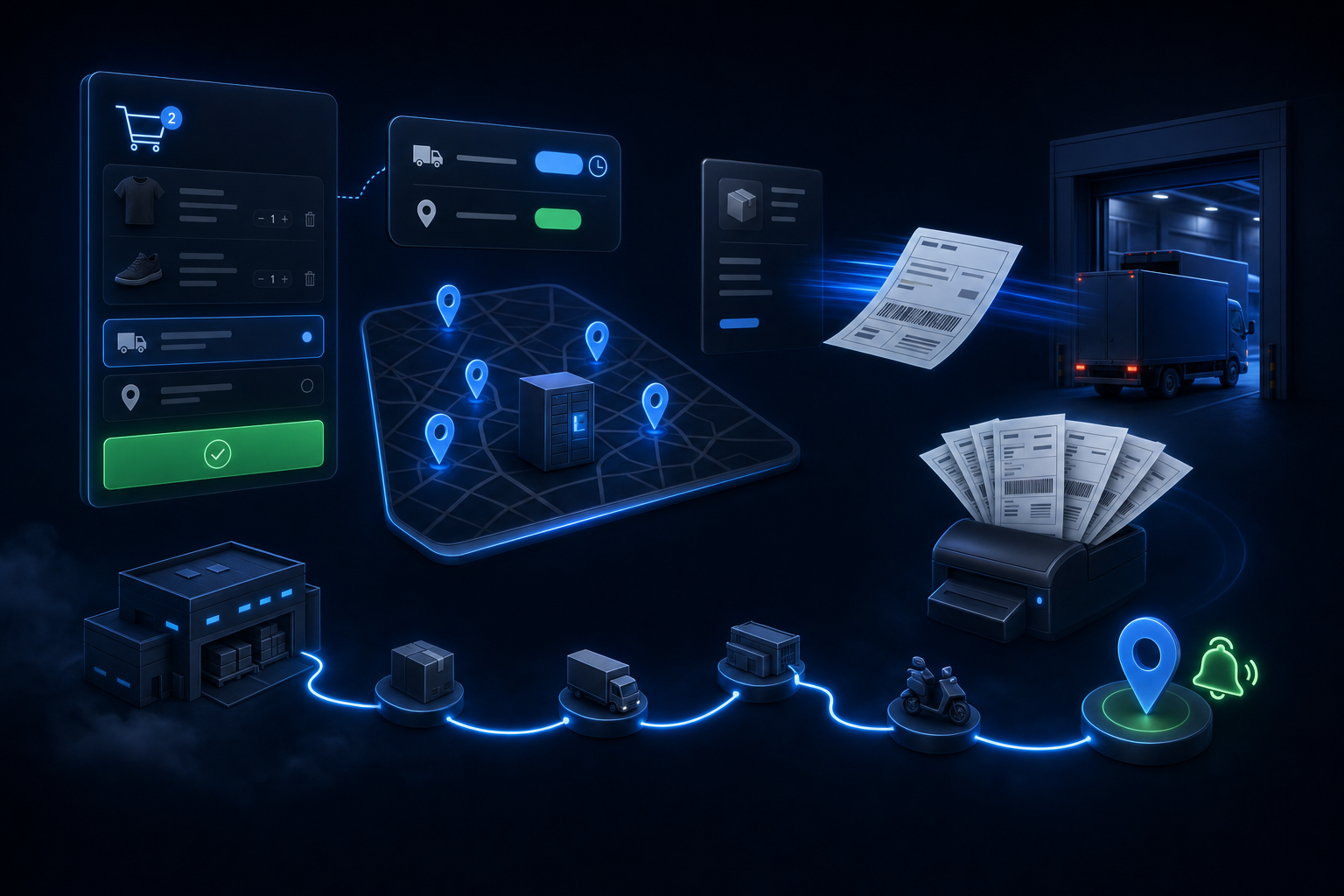
The cart calculator
Carrier tariffs by address and weight in real time: the buyer sees the price before checkout
The pickup map
Points and lockers on a map with hours and timing — chosen in two clicks
Automatic waybills
Order data flies to the carrier via API: no retyping, no address errors
Labels & batches
Batch label printing, shipment registries — dispatch in minutes
Tracking at home
Statuses pull into the order: the client follows on your site, notifications send themselves
Carrier selection rules
Geo, weight, payment type: the system proposes the optimal carrier per order
How the project runs
How the project runs
- 1-2 weeks
Systems analysis
Studying configurations, both APIs, data structures and exchange scenarios
- 1-2 weeks
Exchange design
Data mapping, sync directions and schedule, conflict handling
- 2-6 weeks
Build & testing
Connectors, queues with retries, runs on both systems' staging circuits
- ongoing
Launch & monitoring
Production launch, error alerts, support through system updates
Unclear delivery kills the order before the manager can clarify
A buyer who didn’t see the delivery cost and date in the cart doesn’t wait for a call. They abandon the order and go where the numbers show at once. Delivery uncertainty is one of e-commerce’s main abandoned-cart causes. The carrier integration closes it at checkout. Live rates by address, the dates, pickup points on a map — the buyer decides with the full picture. In the hobby store owner’s review, the calculator alone lifted checkout conversion by 17%.
Pickup points on a map and carrier selection rules
Half the buyers prefer pickup points, and they need a map. Points and lockers near home, working hours, the delivery date to each. For the store the reverse logic works: carrier selection rules. By geography, weight and payment type the system offers the profitable option itself. One region is cheaper by courier, another by post. The multi-carrier circuit stops being three dashboards and becomes one system with shared rules.
Automatic waybills: shipping in minutes
Manual waybill entry is half a manager’s day and address mistakes that turn into returns at the store’s expense. Through the API, an order flies to the carrier with a button. The address, the weight, cash on delivery — from the order’s data, without retyping. Labels print in batches, manifests form themselves. In the cosmetics store head’s review, shipping forty orders takes twenty minutes. Against the former day with mistakes.
Tracking at your place: support stops being an information desk
Where-is-my-order is any store’s main support question, because tracking lives on other people’s sites. The integration brings it home. Statuses pull into the order. The client watches the parcel in your store’s account. Notifications about movement and pickup-point arrival go out by themselves. In the parts store director’s review, the question “almost vanished from the chats”. Support switched to sales.
The whole circuit and the combinations
The full path without manual links. The cart with the calculation → the order → the waybill to the carrier → the label → tracking → the handover, with statuses in the books at every step. The combinations sit nearby. The ERP and inventory sync: orders and statuses in the books. The payment circuit with receipts. The online store itself. The e-commerce infrastructure assembles with one vendor, the cases are in the trio below.
Related case study


Client reviews
Client reviews
The manager-will-calculate-the-delivery cost us a third of the carts: people simply didn't wait. The calculator with pickup points on a map lifted checkout conversion by 17%. The most measurable upgrade in the store's history.
The manager spent half a day on waybills and still made address mistakes — returns at our expense. Now an order flies to the carrier with a button, labels print in a batch. Shipping forty orders takes twenty minutes.
Tracking statuses on our site unloaded support radically. Where-is-my-order almost vanished from the chats: the client watches the parcel's path themselves and gets notifications. Support finally does sales, not inquiries.
Related solutions
Related solutions
CRM Platform Integration
Every lead into the pipeline with its source and no duplicates. The site, calls, messengers and the ERP in one circuit around your CRM.
Bitrix24 Integration
Assembling the portal for the company's processes. Lead channels, the ERP, smart processes and the deal-to-project link — Bitrix24 starts working.
Marketplace Integration
Stock without fines, FBS by process and to-the-cent financial reconciliation. A marketplace integration where the system controls the deadlines.
FAQ
FAQ about integrations
01How much does a delivery carrier integration cost?
One carrier with the calculator, pickup points and waybills — from $2,500 in 2-5 weeks. Each next carrier into the shared circuit is cheaper than the first. The logistics audit and the estimate are free.
02Which carriers do you connect?
The major courier services, postal operators and parcel networks, through the carriers' APIs. We build the multi-carrier circuit with selection rules. The system offers the profitable carrier by the order's geography and weight, not one-for-everything.
03How accurate is the cart calculation?
It's the carrier's live rates by address, weight and dimensions. The same price as in the waybill. Packaging and the logistics markup get set by rules. Accuracy is the whole point: an approximate price that later grows hits trust worse than its absence.
04Do you support cash on delivery and returns?
Yes. Cash on delivery gets set in the waybill automatically, redemption statuses pull into the order, returns get tracked in a separate circuit. For stores with try-ons and partial redemption we configure the carriers' matching scenarios.
05We run an ERP or inventory system — will the integration get along?
That's the target combination. An order from the books goes to the carrier, statuses return to the books and the client. ERP and inventory integrations are our neighboring services. The circuit assembles as one: from the cart to the handover without manual links.
Let’s discuss your project
Free estimate and a proposed solution within one day.